
 Українська
In January 2025 the government has approved The National Waste Management Plan till 2033. This document serves as a roadmap which guides us throughout the reform of the waste management system. To a large extent, the adoption of this document was driven by the Ukrainian government’s implementation of the requirements of the Association Agreement with the European Union and The Ukraine Facility Plan. In 2022 Ukraine became a candidate to join European Union and among other reforms, environmental reform is arguably one of the highest priorities.
Hence, we have a great opportunity to improve the waste management system at the legislative and practical level and to deliver effective change while prioritising environmental sustainability and community welfare.
What do communities need to be aware of? Which legislative nuances and requirements for local self-government bodies are explained by experts from the “Zero Waste Cities in Ukraine” project, supported by the LIFE Programme: Oksana Mylianyk, a legislative expert at Zero Waste Alliance Ukraine and an expert of the Ministry of Environmental Protection and Natural Resources reform support team, and Olha Melen-Zabranna, Head of the Legal Department at the NGO “Environment-People-Law”.
The previous legislation failed to support effective waste management practices.
As Oksama Mylianyk notes, the previous legislation that had been in force for more than 20 years, did not contribute to the establishment of an effective waste management system in Ukraine.
“Even the process of adopting the new law was quite challenging. Many of its details were not always beneficial or clear to various stakeholders, yet the document still entered into force on 9 July 2023,” the expert explains.
The law “About waste management” – this is a frame document that defines the main objectives and measures aimed at reducing waste generation and the rational management of existing waste volumes. The implementation of the law is entrusted to regional councils, local self-government bodies (village, settlement, and city councils), as well as businesses and community residents. All of them are participants in the waste management system.

Oksana Mylianyk:
“The aim of the reform is creating an environmentally safe waste management system based on the principles of the circular economy. Apart from recycling and reuse development, part of the efforts should be directed toward waste prevention. At the national level, certain conditions should be ensured at which the product life cycle is extended at a maximum level, the use of single-use packaging is reduced and the transition to reusable alternatives is supported.”
What’s new?
Let’s pay attention to the key newly implemented laws.
-
Waste management hierarchy
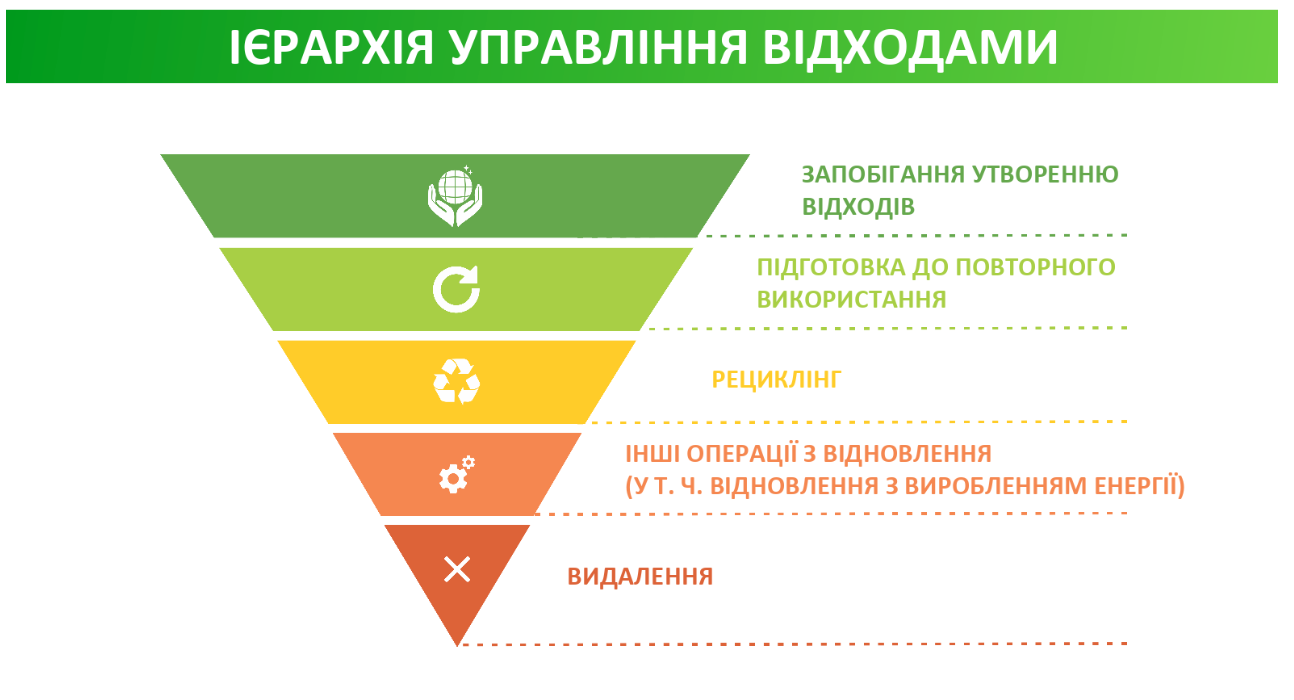 Інфографіка Zero Waste Alliance Ukraine
Waste management hierarchy aims at preventing waste generation and find the most effective use of waste that has already been created.
This can be achieved through the following steps:
- Prevention. The ideal method of waste management. If there is no waste, there is no problem of “disposing” of waste. From the consumer’s perspective, this could mean using reusable containers and buying goods without packaging, while from the manufacturer’s perspective, it could mean reducing excess packaging at the product design stage and manufacturing goods that can be repaired and reused, i.e., that do not become waste for a long time.
- Reuse, if that is imposible to prevent waste from being generated. It is possible to reuse glass bottles, furniture and clothes that has been used as well as repair or rent things.
- Recycling things that can not be reused. As a result, waste is converted into products or materials for new goods, or into substances intended for the same or alternative uses. Recycling typically applies to plastics, glass, paper, and metals.
Organic waste composting is also considered part of this step, but only when the resulting compost or decomposition residues are used to fertilise soil or to create a medium for cultivation.
- 4. Waste recovery, including energy recovery. Here, waste can be transformed into materials that will later serve as fuel or as materials for backfilling
- Waste disposal (landfilling or incineration) is the final and least desirable waste management option. This approach applies to residual waste that is not suitable for composting or recycling. However, by adhering to the higher levels of this hierarchy, such waste can be reduced or its generation can be prevented altogether.
- Extended Producer Responsibility (EPR)
This principle is necessary to ensure that responsibility for the end-of-life management of products does not rest solely with consumers, who are forced to dispose of products they can no longer use or repair. Instead, primary responsibility should lie with producers, who are therefore required to introduce effective waste management systems for waste generated as a result of consumer use of their products.
For example, producers may establish separate collection systems and incentivise consumers to sort waste. They may also raise public awareness of waste sorting, reuse, and waste prevention.
“Mandatory extended producer responsibility requirements will come into force following the adoption of the packaging law, as well as other sector-specific legislation that will implement the EPR principles. At that point, responsibilities for separate waste collection will be shared between companies—namely producers—and local authorities,” explains Oksana Mylyanyk.
- • The “Pay-As-You-Throw” (PAYT) principle
In essence, this is a fee charged for waste that cannot be recycled and therefore ends up being landfilled or incinerated. Notably, compared to waste sorting, this approach to residual waste is significantly more costly for communities. This applies both to households (municipal waste generated by households) and to industrial facilities (air emissions and other forms of environmental pollution).
It is also worth noting that the current Law of Ukraine “On Waste Management” stipulates that, as of 2030, the landfilling of waste will be prohibited at sites that do not have filtration and other treatment facilities in place to prevent hazardous substances from infiltrating soil and groundwater.
- New role in the waste management system — service administrator
A household waste management service administrator should be appointed in local communities with a population of over 500,000. If there are fewer residents, the need for an administrator is determined at a local council meeting.
This refers exclusively to a municipal enterprise that cannot engage in any other activities except waste management. The main task is to ensure the functioning of the municipal waste management system. This involves concluding contracts with business entities to perform household waste management operations (collection, transportation, disposal, and treatment of waste). The administrator also concludes contracts with consumers and, at the same time, issues invoices and informs residents about charges for the services provided.
The administrator may be one or more enterprises serving several communities. If necessary, individual territorial communities may choose a common service administrator.
“This is a very important issue for village and town councils,” says Olga Melen-Zabramna. “After all, we know how often small communities have no one to deal with this. Residents do not pay for the service, but waste must be collected. Therefore, these activities are either subsidized by the local council or someone else at a tariff, and higher tariffs are set so as not to operate at a loss and to cover related expenses. The administrator can take the workload off the executive committees and local government bodies and become a full-fledged provider of household waste management services, thus ensuring that the quality of the service is high.”
An important step in the reform of the waste management system was the adoption of the National Plan in this area until 2033.
Read more in the continuation of the article on the “Decentralization” portal.
The project “Zero Waste Cities in Ukraine” is co-funded by the European Union. The views and opinions expressed are those of the author(s) only and do not necessarily reflect those of the European Union or European Climate, Infrastructure and Environment Executive Agency (CINEA). Neither the European Union nor the granting authority can be held responsible for them.